Never-before-seen temperature and ion density measurements reveal that the effect of Jupiter’s moons on its aurora are more complicated than scientists thought.
…
A newly discovered comet is rapidly brightening and could become visible from Earth — if it survives an extreme close encounter with the sun on April 4.
…
The Hubble and Euclid space telescopes caught a stunning portrait of a dying star at the heart of the Cat’s Eye Nebula.
…
A new study highlights the volcanic Rimae Bode region as a scientifically promising destination for China’s first crewed moon landing mission, which the nation wants to achieve by 2030.
…
The catalog of gravitational waves “heard” by LIGO, KAGRA and Virgo has doubled with detections of spacetime ripples.
…
The ESA’s Mars Express and ExoMars Trace Gas Orbiter spacecraft watched as a superstorm that ravaged Earth also struck the Red Planet.
…
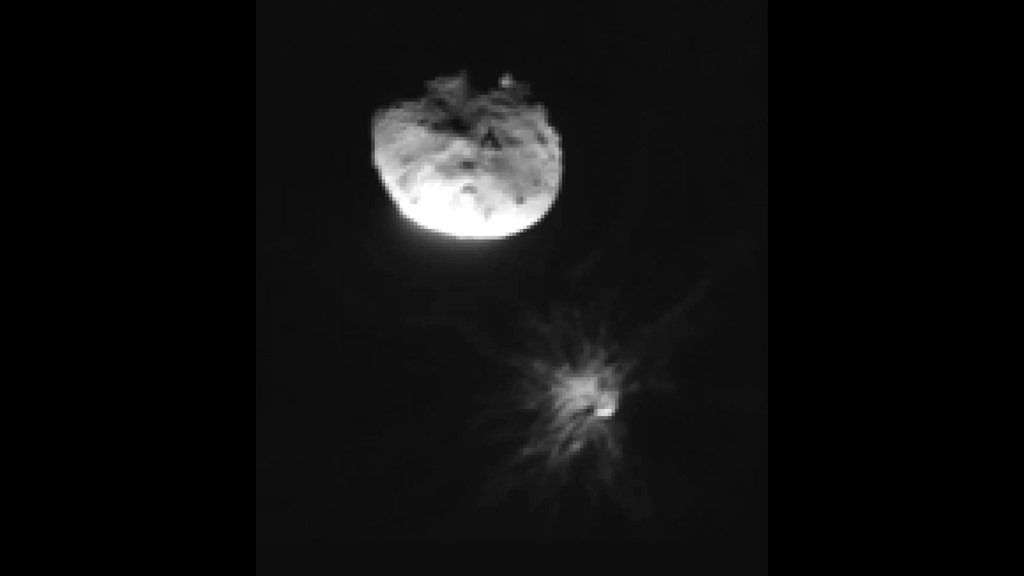
New research reveals that when NASA’s DART (Double Asteroid Redirection Test) spacecraft intentionally impacted the asteroid moonlet Dimorphos in September 2022, it didn’t just change the motion of Dimorphos around its larger companion, Didymos; the crash also shifted the orbit of both asteroids around the Sun. Linked together by gravity, Didymos and Dimorphos orbit each […]
The Milky Way nebula RCW 36 resembles a stunning cosmic bird of prey in an incredible Very Large Telescope image.
Newly released Mars images offer a detailed look at one of the Red Planet’s oldest, most heavily cratered regions, a landscape shaped by billions of years of impacts, volcanism and erosion.
…
The James Webb Space Telescope has revealed our lunar companion is safe for now from an asteroid impact.