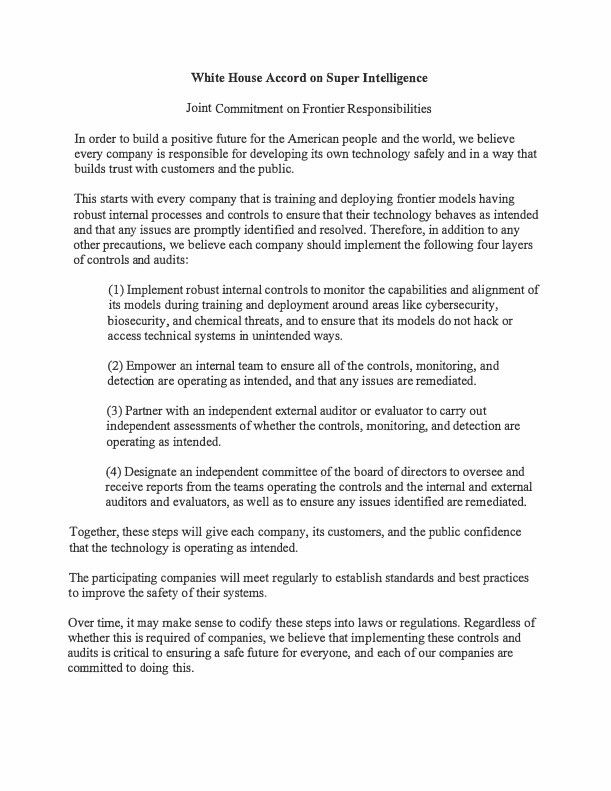
The heads of the biggest AI labs — Google, Anthropic, Meta, OpenAI, SpaceXAI, and Nvidia — went to Washington and signed the ‘Joint Commitment on Frontier Responsibilities,’ promising to develop their own models safely. Trump says that it’s the best way to move forward with AI as it balances progress with safety.
Anthropic has released a frontier red teaming report, claiming that Zhipu AI’s GLM-5.3 has weak safeguarding, and can easily be used to generate harmful content.

Meta’s Muse AI agent has been accused of ignoring user permissions and accessing forbidden personal user data on an iPhone and Mac, including iMessages.
Florida asked a court to bar OpenAI from developing new AI models without third-party approval and to keep minors off ChatGPT.
President Donald Trump issued an executive order directing all federal agencies to stop using the term ‘artificial intelligence’ and instead call it ‘Super Intelligence.’ The president said that the new term will solve AI’s branding issue and that it ‘more appropriately captures the promise, potential, and rapidly advancing capabilities of these technologies.’
The price of AI “intelligence,” has fallen dramatically in recent years, faster than any other transformational technology in history according to some estimates. This raises serious questions about the need to retain access to frontier capabilities, when they show up elsewhere so swiftly.

Cadence, Synopsys, and Siemens all offer agentic AI for chip design, largely built on Nvidia’s stack, with varying claims of autonomy.
A developer trained a JEPA world model, based on LeWorldModel research co-authored by Yann LeCun, on an RTX 3080 Ti to play Pokémon Red.

OpenAI says AI-assisted Jalapeño chip design “established a new baseline” for the industry, and there is already a lot of interest from others to learn how the company pulled it off.