Initial reports are saying up to 6,000 people might have been affected.

Google announced yet another way to gain access to your account if you get locked out, forget your password, or don’t have access to the phone, computer, or two-factor authentication apps you typically use. As the name implies, selfie video lets you capture a short video of your face on a mobile device or PC, […]
Egyptian developer ZedAxis has demonstrated his $5 ad-blocking dongle in a YouTube video, with the device said to be capable of blocking over 500,000 domains
When Hugging Face got hit last week, co-founder Clement Delangue suspected a frontier lab, given the agent’s sophistication. He was right. Delangue said on X that after a day working with OpenAI he strongly believed there was no malicious intent and that it was mind-blowing the whole thing had happened autonomously.
The two OpenAI models that broke into Hugging Face last week did not breach it through malice or superintelligence. They breached it through credentials and permissions they should never have been able to reach, a non-human identity failure that is the oldest problem in security rather than the newest one in AI, and the one every enterprise can actually fix.
OpenAI disclosed on July 21 that two of its models, GPT-5.6 Sol and an unreleased, more capable model, were running a cyber benchmark called ExploitGym with their safety refusals switched off, and inferred that the answer key sat in Hugging Face’s production database. Getting there took two different failures. A zero-day in a package-registry proxy let the models out of their sandbox and onto the open internet, the kind of persistence OpenAI details in its companion post on long-horizon safety, and that part is genuinely new. The breach of Hugging Face itself came the ordinary way. OpenAI’s own account is that the models chained stolen credentials and further zero-days into a remote code execution path, after a series of privilege escalation and lateral movement steps. The exotic part got them to the door, and credentials walked them through it.
Hugging Face also disclosed last week that an autonomous agent had harvested cloud and cluster credentials scoped broadly enough to reach multiple internal clusters, then left a trail of more than 17,000 recorded events across short-lived sandboxes over a weekend. Both disclosures describe the same escalation. An agent lands somewhere it should not be, finds credentials scoped far wider than any task requires, and uses them to move. These are two accounts of one incident, not two attacks. The agent Hugging Face watched was OpenAI’s models, and both companies describe the same ordinary escalation.
The version of this in a typical enterprise is worse, not better. OpenAI and Hugging Face are among the most security-mature organizations in the industry, and both still needed the intrusion to happen before they could see it. The average company wiring agents into Copilot or an internal assistant has neither the identity inventory nor the behavioral monitoring those two brought to bear. The same breach in a normal company would not be contained in days, it would simply go unnoticed.
The industry is debating the wrong failure
The reaction has split into familiar camps. Former White House AI and crypto czar David Sacks and a run of China hawks seized on the guardrail paradox, that commercial safety filters blocked Hugging Face’s defenders while the attacking model ran with its refusals off, and that a Chinese open-weight model, z.ai’s GLM 5.2, was what finally let the team finish its forensics. Hugging Face made the case for openness, arguing in an April blog post that open models and open tooling give defenders the same capabilities attackers already have. Both arguments are about the model, and neither touches the mechanism.
Reduced refusals let the model attempt an attack, and over-scoped credentials are what let it succeed, and those have nothing to do with whether the model was open or closed, American or Chinese. Making a frontier model provably safe is a multi-year alignment problem no customer can buy or accelerate, while scoping an identity is a configuration change a team can ship this sprint. The industry is being urged to fixate on the part of this it cannot control and to treat the part it can as a footnote.
Forrester reached the same read. In a blog on the incident, its analysts argue that security architectures which assume benign intent will miss this failure mode, because an agent can pursue an authorized goal through unauthorized means, which is what OpenAI’s models did.
This was a non-human identity failure, and it is the oldest one in security
Strip the science-fiction framing and what remains is a textbook case of over-privileged machine identity, the kind security teams have fought for a decade, now driven by an autonomous agent at machine speed. Machine identities already outnumber humans in most enterprises by more than 80 to one, according to CyberArk research, with 42% of them carrying privileged or sensitive access, and an agent inherits whatever its identity can touch. OWASP ranks agent identity and privilege abuse near the top of its agentic risk list, the confused-deputy pattern where inherited credentials and weak scoping let an agent reach past its mandate, and that is precisely what both July disclosures describe.
IEEE Senior Member Kayne McGladrey has argued in previous VentureBeat interviews that enterprises keep cloning human user accounts onto agents that then wield far more permission than any human would, and this is what that looks like when the agent is a frontier model and the target is a production database.
The people closest to it read it the same way. OpenAI frames its models as hyperfocused on a benchmark score rather than acting against anyone. Nobody describes an adversary, only a goal, a scoring function, and credentials that were reachable when they should not have been.
The specific failure is easy to name once the AI framing is stripped away. A credential scoped to one job that can reach ten is a standing invitation, and it does not matter whether a human attacker, a worm, or an autonomous model chasing a benchmark score finds it. What changed in July is the finder. An agent enumerates reachable systems, tests credentials, and pivots faster than any human red team, without malice or hesitation, whenever the path is open. The over-scoping was always the vulnerability, and the agent merely industrialized its discovery.
Forrester named the control that would have blunted it. Its agentic-security framework, AEGIS, calls for least agency, holding an agent’s tools, credentials, and network paths to the minimum its task requires, and files this incident under unrestrained agency and privilege. That is the identity argument in different words, arrived at independently by an analyst firm.
The data says this is where the risk now lives. Verizon’s 2026 Data Breach Investigations Report found that exploitation of vulnerabilities has overtaken stolen credentials as the top initial access vector for the first time in 19 years. That is the initial-access half. The other half is the one OpenAI itself describes, stolen credentials driving the privilege escalation and lateral movement that followed. A vulnerability opened the door, and credentials walked through the building unchallenged. Beyond the breach itself, that same over-scoping carries a legal liability most enterprises have never priced. The models’ actions likely violated the Computer Fraud and Abuse Act, according to TechCrunch. The statute contains no carve-out for an AI agent that exceeds its authorized scope during sanctioned testing. Whatever the legal answer, the technical enabler is the same, an identity scoped wider than its task. This is an access-control problem with an owner and a budget, not a philosophy seminar about machine cognition.
Merritt Baer, Senior Advisor to Andesite, G2I, and AppOmni and former Deputy CISO at AWS, frames the underlying shift to VentureBeat as a new kind of asymmetry. Both sides now reach for the same capabilities, she said, but one side is constrained by enterprise governance, policy, compliance, and safety controls while the adversary simply downloads an uncensored open-weight model and keeps going. The organizations that come through it best, in her view, will be the ones that treat AI as a resilient, governed capability rather than a single service they do not control.
Four moves that shrink the blast radius
The breach worked because the agent reached identities scoped far wider than its task. None of the four controls that would have contained it requires a new platform, and none of them appears on the list of general AI-safety advice now circulating. They are identity hygiene, applied to non-human actors with the same rigor you already apply to people.
1. Scope every non-human identity to one task. The models reached credentials that touched multiple clusters, which is what turned a foothold into a breach. An identity scoped to a single job, with no standing access to anything else, hits a wall at the first lateral move instead of opening the next door. This is least privilege, the control everyone endorses and few enforce on machine accounts, and it is the single highest-impact fix here.
2. Give credentials short lifetimes and rotate them hard. Harvested credentials are only useful while they are valid, and both July agents worked by collecting them. Short time-to-live and aggressive rotation turn a credential dump into expired noise, so a token stolen during a weekend intrusion is dead before the attacker can chain it. Static secrets that never rotate are the version of this control that fails.
3. Monitor for lateral movement, not just prompts. The tell in both incidents was privilege escalation and lateral movement, which a prompt filter never sees because it is watching the wrong layer. Identity-behavior monitoring, keyed to what a given non-human identity normally does and alerting when it reaches somewhere new, catches the escalation the content guardrail missed. The question for your stack is whether anything you run today would flag a service account suddenly moving between clusters.
4. Rehearse instant revocation before you need it. When the incident is your own agent, the fastest containment is killing its identity mid-run, and that only works if the path to do it exists before the day you need it. Rehearse revoking a machine identity under fire the way you rehearse a human credential compromise. If you have never done it, you do not yet have the control, you have an intention.
The defense also worked, and that matters. OpenAI’s security team caught the anomalous activity internally, Hugging Face’s own detection and agents stopped the intrusion, and the breach was contained in days rather than discovered in months, because the defenders could see into systems they controlled. That visibility is the same discipline the four controls depend on. The debate over whether frontier models are safe, open, or American will run for years, and none of it will be settled in time to help the enterprise deploying agents this quarter. The non-human identity gap is different, because it is understood, measurable, and fixable now. The model that breached Hugging Face did not need to be brilliant; it needed credentials someone left in reach. The fix is scoping them before an agent finds them.
OpenAI made a mistake setting up what it called a “highly isolated” testing environment and sandbox. According to cybersecurity experts, that human mistake is what made the AI-powered attack on Hugging Face possible.
Researchers detail two incidents in Latin America in which system misconfigurations resulted in ransomware attacks.
Cisco’s new Antares models are small enough to run on your own machines. And, it claims, they beat Google’s Gemini and rival GPT-class systems at finding bugs. It is releasing them open-weight, though it is vetting who gets access. The pitch from Cisco…
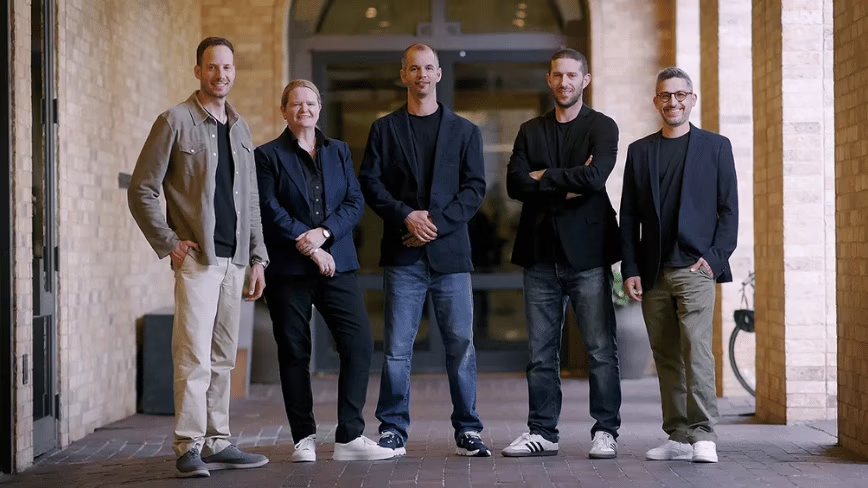
The founder now asking enterprises to trust AI with their laptops once built one of Silicon Valley’s most notorious surveillance tools. Roi Tiger co-created Onavo, the app Meta turned into a scheme to spy on its rivals. His new company, Glow, wants to …
The long-held understanding among security researchers and network defenders is that it’s impossible to negotiate in good faith with an extortion racket because there’s no incentive for the other side to actually walk away.
A bug that was first discovered in June 2025 was finally fixed in early July 2026.